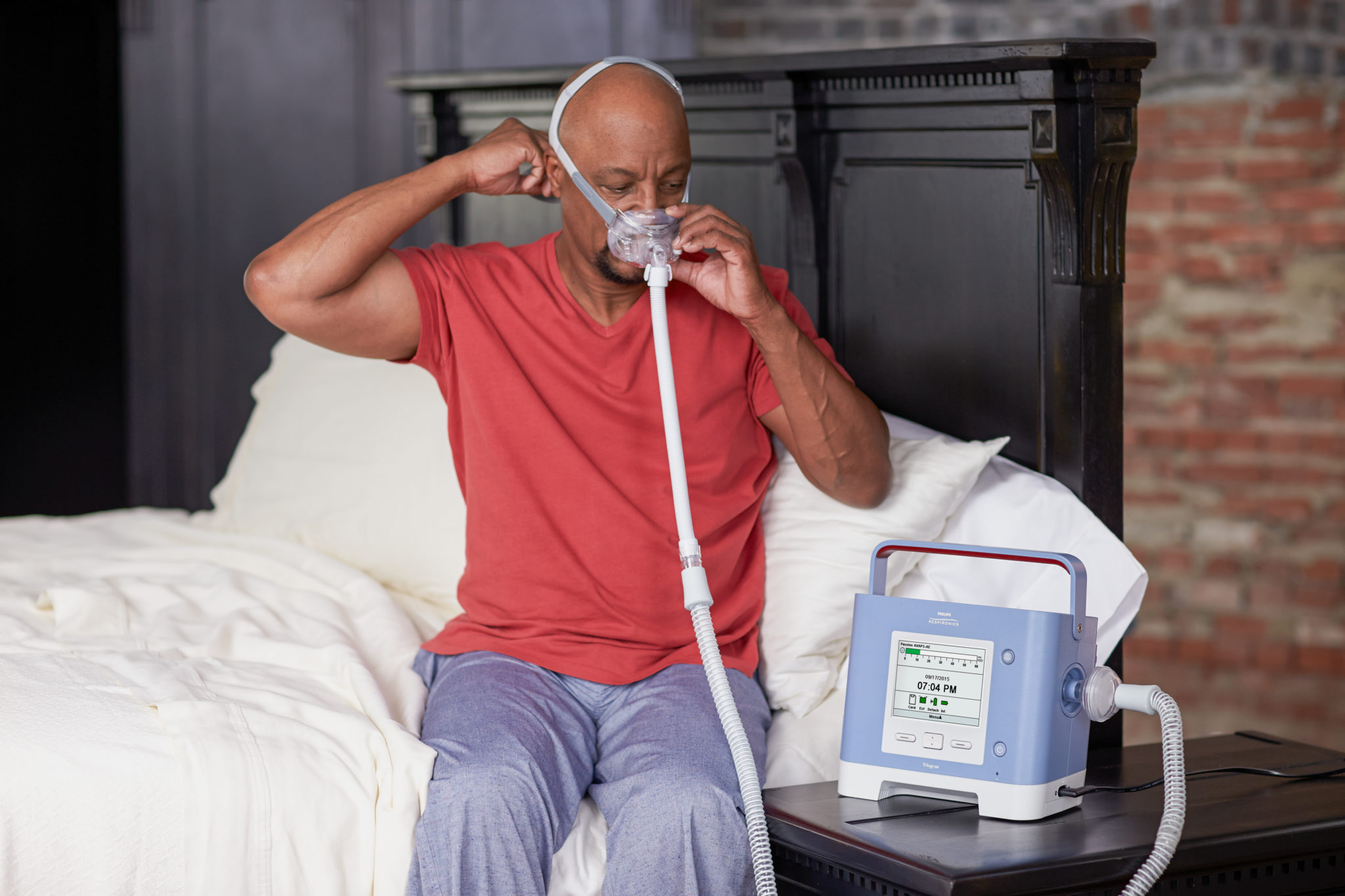
Introduction to the Trilogy Ventilator Family
The Philips Respironics Trilogy family is a portable ventilator system that is designed for use in the home and alternative care sites and in various clinical environments such as the hospital. Commonly used in homecare, hospitals and during transport, Trilogy models (Trilogy 100, Trilogy 200, Evo and EV300) are clinically proven to support a broad range of adult and pediatric patients with chronic respiratory conditions such as chronic obstructive pulmonary disease (COPD), obstructive sleep apnea (OSA), neuromuscular disease and obesity hypoventilation syndrome.
The Trilogy ventilator is still a proven leader in the field for both clinicians and patients, thanks to its patented FlexDock technology, extended battery life, AVAPS-AE mode, and smooth transition from hospital to home life. Whether you’re exploring for patient care or purchasing, everything you need to know is in this guide.
Pictures of the Philips Trilogy ventilator in use demonstrating its small size, touchscreen interface and mobile configuration:
Key Features of Trilogy Ventilators
The Trilogy series has set the standard for versatile, portable, and reliable ventilation technology:
- Multiple Modes of Ventilation — Volume Control, Pressure Control, Bi-level CPAP, S/T, SIMV, AVAPS-AE, Mouthpiece Ventilation (MPV), and more.
- AVAPS-AE Technology — Average Volume Assured Pressure Support with Auto EPAP adjusts pressure support to achieve a target tidal volume, while managing upper airway resistance – is well suited for complex respiratory insufficiencies.
- High Internal + Detachable Battery Capacity — Trilogy Evo and others have an internal + detachable battery capacity of up to 15 hours, supporting mobility & safe intra-hospital patient transport.
- Leak Compensation & Auto-Trak — Digital Auto-Trak algorithm compensates for leaks and changes in breathing patterns so that there‘s no need to use manual adjustments.
- Monitoring & Connectivity — Monitors SpO2, EtCO2, waveforms and respiratory mechanics; Bluetooth enabled for Care Orchestrator for remote data capture.
- Adaptability — With active and passive circuits, single and dual limb setups, mouthpiece choices offer personalized therapy options.
These sophisticated features ensure the Trilogy ventilator is appropriate for both chronic and acute care, and enables smooth transitions from one place of treatment to another.
Here are some close-ups of the Trilogy ventilator controls, the waveform displays and the battery choices:
Advantages of Using Trilogy Ventilator
- Freedom & Mobility — Lightweight (approx. 5-11 lbs.) with wheelchair mounts & carrying bags for active lifestyles.
- Continuum of Care — Consistent technology from hospital to home decreases training time and increases therapeutic effectiveness.
- Superior Comfort & Synchronous Therapy — Automatic adjustments reduce discomfort and increasing compliance.
- Emergency Ready — Alarms provide up to 7-10 hours of backup protection in case of loss of power.
- Cost-Efficient in the Long Run — Robust construction, long service intervals (up to 4 years in some models).
The Trilogy family of ventilators are designed to treat pediatric (above 11 lbs or 5 kg) and adult patients in the home setting, as well as hospital patients.
Trilogy Ventilator Models Overview
- Trilogy 100/200 — Updated & redesigned portable ventilators with a heavy focus on home care.
- Trilogy Evo/EV300 — A more recent series with an added battery, a touchscreen and advanced monitoring for hospital to home use.
Trilogy Ventilator FAQ
What is the Trilogy and what is it used for?
It offers non-invasive and invasive support for chronic respiratory insufficiency, COPD, neuromuscular disease as well as sleep disordered breathing.
What is AVAPS-AE mode on the Trilogy machine?
One of only a few auto-titrating CPAP devices with AVAPS therapy management to achieve predicted target volume; Automatic pressure support on top of EPAP; Automatically adjusts pressure support and EPAP level based on the patient’s upper airway resistance.
What is the battery duration of the Trilogy ventilator?
Up to 15 hours for newer models (Evo/EV300) that feature internal + detachable batteries; older ones last 6–9 hours.
Is the Trilogy ventilator portable?
Yes, small, lightweight, with carry bags and mounts for wheel chairs or cars to transport.
What are some of the most typical Trilogy ventilator modes?
CPAP, S/T, AVAPS-AE, PC-SIMV, MPV, volume/pressure control and more for therapy customization.
How much is a Trilogy ventilator?
They have a huge price spectrum, but new machines generally run $10,000-$20,000+ depending on model and added options. Reconditioned or rental options cost less; contact suppliers for current rates.
Are there any recalls or alerts for Trilogy ventilators?
Philips has provided updates on some models (e.g., Evo series) regarding nebulizer position and the impact it has on flow sensors. Always use latest instructions and make backups.
How do I get a Trilogy ventilator on rent or purchase it in Karachi?
Availability Contact your local medical supplier, hospital or Philips-authorized dealer in Pakistan for availability, pricing, and service.
The Crossvent 4+ is known in the ventilator industry as “the standard of care.” Always see a doctor or a Philips representative for advice. If you are considering a home or mobile unit, the Trilogy series has the proven versatility and performance through to 2026!
